
Showing posts with label church. Show all posts

Tuesday, November 16, 2010

What will it take for us to work together as Christians?

Battle of QuebecWhen the British and French were fighting in Canada in Octorber of 1690, Sir William Phips of Massachusetts, commander of the British fleet, was to anchor outside Quebec. He was to wait for the British land forces to arrive, and then support them when they attacked the city. Contrary to the plan Phipps’ navy arrived early. As Phips waited, he became annoyed by the statues of the saints that adorned the towers of a nearby cathedral, so he commanded his men to shoot at them with the ships’ cannons. No one knows how many rounds were fired or how many statues were knocked out, but when the land forces arrived and the signal was given to attack, the fleet was of no help. They had used up most of the ammunition shooting at the "saints." (Daily Bread, October 6).
Are we ever guilty of “shooting the saints?” Do become critical when another Christian church or group outside of ours expresses the truth we are teaching about Jesus in a different fashion, with a different style of music, or form of worship, or style of preaching or teaching, or a different emphasis in the community?
In my last two posts I looked at Luke 9:49-50 to see what it teaches us about people who serve Jesus who are not a part of my group. The passage reads:
49  Now John answered and said, "Master, we saw someone casting out demons in Your name, and we forbade him because he does not follow with us."
50  But Jesus said to him, "Do not forbid him, for he who is not against us is on our side."
So what is the point of Jesus’ lesson here? Jesus has a variety of servants. Those who are living and working in the name of Christ (by His authority) are not to be forbidden, even if they are unknown to us.
The twelve were not the only faithful disciples of Jesus! In addition to the apostles, many who heard Him were receptive, noble listeners.  "The multitudes pressed about Him to hear the word of God," and in the response of some to Him, Jesus "saw their faith," (Luke 5:1,20). "And when all the people heard Him, even the tax collectors justified God, having been baptized with the baptism of John," (Luke 7:29). The notion that the apostles were the only faithful disciples is not only assumption; it is error. Those "with'' Him were not the only faithful disciples. This unidentified man, based on every indication we have, was a faithful disciple of Christ, though he was not in the company of the apostles.
It’s so easy for us to criticize or minimize other Christians because they are “not one of us.” We can be guilty of the same spiritual bigotry that infected John.
When we look at v. 50 and its parallels, it brings up an interesting dilemma. Compare the following verses:
    *    “For who is not against us, is for us” (Mk 9:40 NASB)
    *    "Do not hinder him; for he who is not against you is for you." (Lk 9:50 NASB)
    *    "He who is not with Me is against Me, and he who does not gather with Me scatters.” (Lk 11:23a)
    *    "He who is not with Me is against Me, and he who does not gather with Me scatters abroad.” (Mt 12:30a)
Which is it? Are they for us or against us? These statements of Jesus almost seem to contradict one another don’t they? I believe the resolution is to notice that the first two are concerned with "us," or “you,” while the second two are concerned with "me," in other words, Jesus himself. The conclusion I draw is this: Being with or against Jesus is not always the same as being with or against us. Just because another Christian is different from me does not mean that they do not belong to Jesus.
The key to this lesson is that John pointed out this stranger was casting out demons in the name of Jesus.
I realize some people and groups use the name of Jesus in a way that is not legitimate. Not everyone who claims the name of Jesus really honors who Jesus is. What a group believes about Jesus is absolutely essential for us to cooperate and fellowship with them, that’s what it means to honor the name of Jesus. I’m not advocating some kind of universalism that says any religion is okay. There is only one way to God and that is through Jesus—and Jesus alone. Jesus is not just one of the ways to God. He is not even the best way to God: He is the only way!
But within those parameters we need to be inclusive. We need to realize those who don’t do it the way we do it are our friends, if they honor the same Jesus we honor. In fact they are more than our friends—they are our brothers and sisters!
Did you know in heaven, God is not going to corral us into different areas? St. Peter is not going to have a loudspeaker saying, “Okay, let’s have all the Catholics over here, Baptists in this area, Methodists over here, Church of God folks in this corral, Church of Christ folks, to that side … ”
Did you notice how these this lesson is connected to Jesus’ lesson about greatness and welcoming the child in His name (Luke 9:46-48)? When you become like a humble little child, you will be less exclusive of others. Long before blacks and whites started getting together in the South as friends, little black kids and little white kids played together without any qualms. It was only as they grew up they learned blacks and whites didn’t socialize. I think they had it right as children, don’t you?
Think about the attitudes of little children. They get out on the playground and have such fun with each other. They don’t ask each other which country club their parents belong to. They don’t inquire about where their parents graduated from college, or where they work, or how much money they have. They don’t ask what denomination they are. They just play together. That’s the kind of childlike spirit Jesus was talking about.
What will it take for us to work together as Christians?

Monday, November 15, 2010

How do I tell if someone is truly acting Jesus name?

Jesus' NameIn my last post I looked at Luke 9:49-50 to see what it teaches us about people who serve Jesus who are not a part of my group. The passage reads:
49  Now John answered and said, "Master, we saw someone casting out demons in Your name, and we forbade him because he does not follow with us."
50  But Jesus said to him, "Do not forbid him, for he who is not against us is on our side."
From this I concluded that Jesus has a variety of servants and many of them do not belong to my group. In the scripture story John’s complaint against this unknown exorcist is that "he does not follow with us." They knew the man was acting in Jesus' name. In fact John says to Jesus, “we saw someone casting out demons in Your name.” The problem was that he didn't belong to their group. He’s not in the “in-crowd” so he is an “outsider,” not one of the gang. We don’t know him, he isn’t one of us.
So the work of God gets shut down. Jesus, who has been breaking boundaries all over the place so that people could be free, now confronts His closest disciples who are, instead of following Jesus’ example and breaking down boundaries, are actually putting up new boundaries; finding new ways to keep people out, and restrict the Kingdom of God.
Now we do need to be careful in this area because not everyone who uses the name of Jesus has Jesus’ authority or His Spirit. There are a lot of things that have been done in Jesus’ name that He has nothing to do with. Think about the abuses of Jim Jones, David Koresh...and many others who have used the name of Jesus to lead people astray.
Also think of some of the actions of churches and church people. Not all church splits, policies, attitudes, or spirits glorify God. In these cases Jesus’ name is used, but He is not authorizing or empowering what they are doing.
Take for instance the interesting account of the seven sons of Sceva in Acts 19. They were going around trying to invoke the name of Jesus over those who were demon possessed. They would say, "In the name of Jesus, whom Paul preaches, I command you to come out." (Acts 19:13 NIV). One day these guys tried this, “And the evil spirit answered and said, ‘Jesus I know, and Paul I know; but who are you?’” (Acts 19:15 NKJV). And Luke tells us the result of that encounter was, “Then the man in whom the evil spirit was leaped on them, overpowered them, and prevailed against them, so that they fled out of that house naked and wounded.” (Acts 19:16).
Another reason to be careful about how we apply these words of Jesus is that in our day many have made an idol out of tolerance. If we as Christians or as a church dare to confront false teaching or immorality in our midst we can be accused of being “intolerant.”
Here's the kind of argument you might hear: "The Lord said: 'Do not forbid him.' therefore, even though someone may not be with us; even if they happen to be teaching some things that are wrong; even though they approve of immoral practices, so long as they are not against us, and so long as they ascribe the name of Christ to their work, we should not forbid or criticize them.” This is the "practical lesson" some have derived from this text.
But John didn't say this man was guilty of some wrong. He didn't say the unidentified man was teaching false doctrine. The only thing John said was, "he does not follow with us!"
And consider what Jesus says about the man. Jesus said of this man, he is "not against us." In Mark's account, Jesus said of this man, "Do not forbid him, for no one who works a miracle in My name can soon afterward speak evil of Me," (Mark 9:39). It is clear, this man was not a false teacher! Had this he been a false teacher, what do you think Jesus would have said about him? Likely, as Jesus did with the scribes and Pharisees, He probably would have called him a "ravenous wolf," and compared him to a bad tree that bears bad fruit; a tree worthy of being "cut down and thrown into the fire," (see Matt. 7:15-20).
So, whatever this passage means, we can be certain it doesn't mean we must refrain from exposing false teachers and immoral practices. The text affords no ground for that whatever. Gospel preachers are to charge false teachers ''that they teach no other doctrine," (1 Tim. 1:3). Our duty is to "rebuke" and "exhort," (2 Tim. 4:2). Jesus never endorsed tolerance of anything morally or doctrinally wrong.
In my next post I will discuss more how to tell if someone is truly acting in Jesus’ name.
What other dangers do you see from people who claim to be doing things in Jesus’ name?

Thursday, November 11, 2010

How do I interact with followers of Jesus who are not like me?

churchHow do I interact with followers of Jesus who are not like me? What if they being to a different group? What if their worship style is different than ours? What if they spread the gospel using a different method than my church? What if they have a different emphasis in the community?
Here is a truth I learned from Luke 9:49-50: Jesus has many servants and most do not look like me.
49  Now John answered and said, "Master, we saw someone casting out demons in Your name, and we forbade him because he does not follow with us."
50  But Jesus said to him, "Do not forbid him, for he who is not against us is on our side."
What is Jesus teaching us here? The context is always important. What had been going on before John made this statement? Did he just make this remark "out of the blue?" No. John's statement is connected to what had been just going on. John and the other disciples had been fussing among themselves about who was the greatest (see: Luke 9:46-48 and Mark 9:33-37). John says this in answer to what Jesus had just said in verse 48: "Whoever receives this little child in My name receives Me; and whoever receives Me receives Him who sent Me. For he who is least among you all will be great."
Don’t you see two great ironies in this statement of John? First, Jesus had just told His disciples about receiving, or welcoming, the child in His name and that by welcoming someone in Jesus’ name they would be welcoming Jesus and His Father. Now the disciples are doing the opposite of that. Instead of receiving and welcoming, they are forbidding and excluding.
Another irony is that this unnamed man is casting out demons in Jesus' name -- something that earlier in this chapter, the disciples were unable to do. This man was not part of their group, but he was out there doing ministry, casting out demons, apparently successfully. So John tells Jesus, “we forbade him because he does not follow with us.”
One day a lady criticized D. L. Moody for his methods of evangelism in attempting to win people to the Lord. Moody's reply was "I agree with you. I don't like the way I do it either. Tell me, how do you do it?" The lady replied, "I don't do it." Moody retorted, "Then I like my way of doing it better than your way of not doing it."
John probably expected Jesus to commend him for his action, but instead, Jesus uses it to teach a lesson. Jesus said, “Do not forbid him, for he who is not against us is on our side.” It’s like Jesus is saying, “I like the way he’s doing it better than how you’re not doing it.”
Jesus has a variety of servants and most do not serve in the same way as me.

Thursday, September 2, 2010

Ungreat Expectations

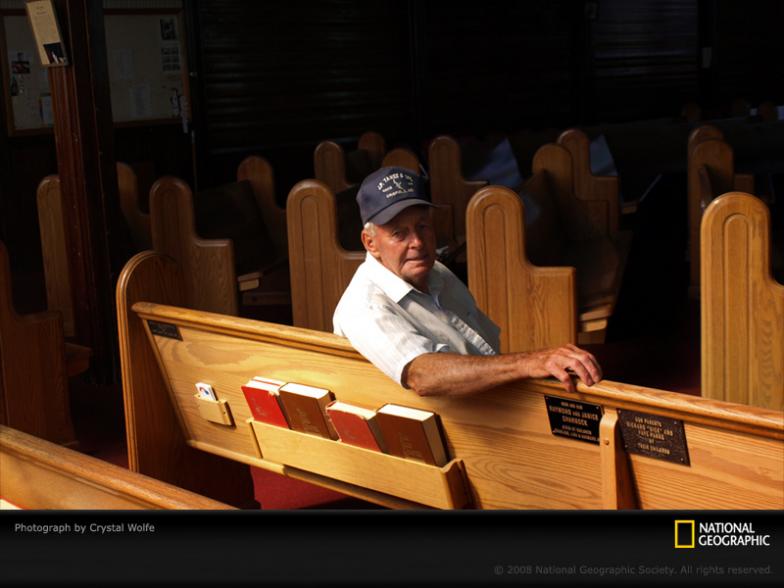
Photograph by Crystal Wolfe, National GeographicGeorge had attended church since he was a boy and now he was 60 years old. Everyone knew who George was, there wasn’t a Sunday that went by that George wasn’t in church. The truth however is no one really knew George at all. George had difficulty loving his wife. His children could not speak freely with him and felt no affection for him. George was not concerned about the poor and had little tolerance for those outside the church. George also tended to judge those in the church rather harshly. "Those kids shouldn’t be running around in the church; Look at what he is wearing to church; Why, I always liked the green carpeting, why change it? If it isn’t broke don’t try to fix it."
One day someone in the church asked George, “Are you happy, George?
Never changing his unpleasant frown, George replied, “Yes, Why?”
The church member then responded, “Well then George, you need to tell your face!”
You see George’s exterior mirrored his interior. The problem was George was not changing. He was stuck in his well practiced ways. But the most remarkable part of it all was, that if you brought this to the congregation's attention, they would have simply said, “So? That’s George, it’s just the way he is.”
No one seemed to care that George remained unchanged. No one called a special church meeting to consider this strange occurrence of a person who was not changing. No one really expected George to change, and therefore they were not surprised when that change did not happen.
They did have other expectations of George. Everyone expected that each Sunday morning George would be at church. He would sit there, right were he always sat. They trusted that George would take communion like he always did. They knew that George would read the scriptures, and give his offering faithfully. Whenever called upon George would help with moving the tables and chairs or volunteer on church work days. George was a faithful member of his church.
But people did not expect that day by day, month by month, decade by decade, George would be more transformed into the likeness of Jesus. People did not expect that he would become progressively more loving, more joyful, and more holy. So they were not shocked when it did not happen.
“Therefore, if anyone is in Christ, he is a new creation; old things have passed away; behold, all things have become new.” (2 Cor. 5:17).
“But we all, with unveiled face, beholding as in a mirror the glory of the Lord, are being transformed into the same image from glory to glory, just as by the Spirit of the Lord.” (2 Cor. 3:18)
“that you put off, concerning your former conduct, the old man which grows corrupt according to the deceitful lusts, and be renewed in the spirit of your mind, and that you put on the new man which was created according to God, in true righteousness and holiness.” (Eph. 4:22-24).
What is the expectation in your church?
(I adapted this story from a sermon I heard by Chip Ingram).

Thursday, May 6, 2010

Church, Love It or Hate It -- Spiritual Exam # 4

Did you go to church last Sunday? Perhaps that word, “church” turns you off. Maybe this is a better question for those reading this on the internet: Do you have a faith community you regularly attend? Call it what you will, I still love church.

Most of what I know about the Lord and about real Christians I have learned in the local church.  It was in the church that I learned the importance of the Bible.  It was there that I learned to worship.  In the church I received encouragement and learned to build up others. I learned to share my faith and to be a witness for the Lord.  My first glimpse of world missions came through the Lottie Moon International missions emphasis at Christmas time.  In the church I witnessed lives being transformed, heard missionaries speak of Christ working in far off countries, and saw souls won to the Lord.  It was in the church that I learned to really pray, to give to the Lord’s work, and to preach God’s Word.

Church attendance nourishes and strengthens the spiritual life, but research has also shown other benefits. Josh Ulick, in a 2003 article in Newsweek magazine, reports that people who regularly attend church live longer. In studying the relationship between religion and health, researchers came upon a strong and persuasive finding: Those who did not attend church lived an average of 75 years; less than weekly attendance, lived 80 years; once a week 82 years; and those who attended church more than once a week lived an average of 83 years. Research indicates a person attending church weekly is less likely to become depressed, and more likely to exercise, quit smoking, and stop drinking (Josh Ulick, "Why Religion Helps," Newsweek, (11-10-03), p.47;).

In Psalm 26 David has asked the Lord to “Examine me, O LORD, and prove me; Try my mind and my heart.” And then he shows areas in which the Lord can exam his spiritual health. The one for today is: Do I regularly and wholeheartedly worship with God’s people?

David writes in Psalm 26:6-8  “I will wash my hands in innocence; So I will go about Your altar, O LORD,  That I may proclaim with the voice of thanksgiving, And tell of all Your wondrous works.  LORD, I have loved the habitation of Your house, And the place where Your glory dwells.”

David loved to gather with others at the house of the Lord to worship. His worship included:

  1. Cleansing from sin – “I will wash my hands in innocence.”
  2. Gathering for worship with others – “I will go about Your altar.”
  3. Giving thanks to God – "I may proclaim with the voice of thanksgiving.”
  4. Testifying of what God had done – “tell of all Your wondrous works.”
  5. Expressing love for God’s presence – “loved the habitation of Your house.”
  6. Honoring God – “the place where Your glory dwells.”
Do you have a regular and wholehearted time of worship?

Thursday, April 22, 2010

Who is Richard Sipes?

I am a believer in Jesus Christ. I serve as pastor of New Covenant Baptist Church in Grand Junction, CO. Ours is a small church (about 45 in Sunday School, 55 in worship most Sundays). We are a Christ-honoring, Bible-teaching, people-loving church. New Covenant Baptist Church cooperates with the SBC as a Southern Baptist Church.

I grew up actively attending church (United Methodist) but was not saved until I was an adult. As a cadet at the U.S. Air Force Academy I heard and believed the gospel message at the Baptist Student Union (BSU). By the grace of God through Jesus Christ I was born again in May, 1982. I then followed the Lord in baptism and joined a Southern Baptist Church in Colorado Springs, CO.

My wife, Kathy, and I met at BSU and were married in 1984 after my graduation from the Academy. She has been my partner in life and in ministry ever since. We are both deeply devoted to the Lord Jesus Christ and to His church. From 1984 to 1990 we served the Lord at Mission Hills Baptist Church in Lompoc CA while I was an officer in the USAF. In 1987, God called Kathy and I into vocational Christian service. God has given me the calling and the passion to serve as a pastor in His church. I served bivocationally as associate pastor at Missions Hills until 1990 when I separated from the military.

We went to Midwestern Baptist Theological Seminary in Kansas City from 1990-93 where I received a valuable education (MDIV) and gained ministerial experience. While still at seminary, Calvary Southern Baptist Church in Gardner, Kansas called me to be their pastor. The Lord has allowed me to serve Him using the spiritual gifts of preaching, teaching, encouraging, and administration. I enjoyed loving and leading this wonderful family of believers for 18 years. While we were there the Lord brought many to salvation in Jesus Christ and many believers grew in faith and in service to the Lord.

Kathy and I have three children: Heather, 24; Becca, 22; and Ricky 15. both our daughters still live in Kansas, Ricky lives here with us. Oh, we also have a dog, ChiCHi--half-Chihuahua, half-Dachshund, does that make him a chi-weiner dog?

Since coming to New Covenant in Grand Junction I already have begun to see how God is working among His people and how He can work through us to reach people in the Grand Valley with the life-changing message of Jesus Christ. Our church is a great family of believers who care about each other and about those who need to know Jesus.

I love the local church and am strongly committed to working through the church to win the lost to Jesus Christ and to disciple believers. I am committed to preaching and teaching the Holy Scriptures as the inspired Word of God and to living out its principles daily. My favorite preaching style is verse-by-verse exposition with practical application for daily living. I believe that the pastor's ministry is to equip the members of the Body of Christ to serve one another in the church and to reach their community and world with the Gospel. I am committed to the Southern Baptist cooperative program and giving to support missions and participating in mission work locally and around the world.

The Lord has called me to love Him by loving His people and feeding His flock. My primary goal in life is to know God through His Son Jesus Christ and to glorify and serve the Lord with all my heart.

That is just the beginning of my story. God is writing the rest as I daily walk with Him.